ABOUT THE BEEKEEPING PODCAST

If you are interested in becoming a beekeeper, or you want to become a better beekeeper, join me for thoughts on beekeeping in the news, honeybee research, book and equipment reviews, interviews, and other beekeeping topics.

Subscribe in iTunes

Subscribe in Zune

Thursday, April 16, 2009

The Beekeeping Podcast - Episode 006 - Weather for Beekeepers

The weather plays a big part in the beekeepers life. Not only are there good and bad times to check your hives, but also great websites that beekeepers can use to help them get the most out of good weather opportunities.

I also mention these websites in this episode:

Listener Sites:

Weather Websites:
To subscribe via iTunes: Subscribe in iTunes

Thursday, April 9, 2009

First Sting and Reversing Spring Hives

Today was one of the warmer days forecasted for the week so I headed out to the hives. First and foremost, my goals were simple, to reverse each of the brood boxes in order to assist in preventing swarming and to super my hives in hopes of catching some of the spring nectar flow. Because bees move up high in the hive during the winter the bees think they are running out of room so they swarm. Reversing the brood boxes gives the bees plenty of room upstairs. The spring nectar flow is on, so I may be able to catch some of the nice, light spring honey.

When I arrived at the hives I saw plenty of activity outside of each one. Here's how each one looked:

Genesis Observations: A hive full of bees. Bees everywhere! Lots of capped brood, burr comb, and drone comb. The top and bottom brood box had ample stores of honey, nice dark, capped with almost a blackish color wax. I was challenged by multiple bees and the smoker kept them at bay for the most part. However, several bees made it up my pant leg and one managed to sting me. The effect was lessoned by my thick white sock, where later I found the stinger. It felt like a needle prick. No redness or swelling, but I doubt that I got anywhere near the full effect.

This hive looks strong. Plenty of bees, honey, and activity that gives me confidence in the health of this hive. I removed the screened bottom board tray and saw lots of pollen, debris, and yes, mites. I'll have to do a spring count soon. No swarm cells.


Exodus Observations: This hive has always been the weaker? of the two. I'm glad I can compare them. These bees are generally smaller in size, a little more lethargic, but willing to challenge me quicker then Genesis. There were plenty of bees, some capped brood, and I managed to spot Mrs. Exodus herself making her rounds. She was in the bottom brood box in the middle frame. Surprisingly, the frames were not as full of honey like Genesis, but the bees were packing in pollen and some nectar. I'd say that this hive was 1/2 of the weight, population, and capped brood of Genesis. Similarly, the screened bottom board tray was full of debris and dead mites, at least 6 months worth of gunk.


Friday, March 27, 2009

Interesting Article on Colony Collapse Disorder

I just read an article, published by the BBC on March 5, 2009, regarding Colony Collapse Disorder (CCD). CCD has been blamed for the recent disappearance and/or failure of honeybee hives around the world. According to the article, in the U.S. alone, over TWO MILLION hives have been lost! There are dozens of theories about the exact causes of this phenomenon, but no hard evidence as of yet. The basic gist of the article is that some scientists believe that there is no one direct cause of CCD and that it may be, in fact, due to multiple events including rise in parasite populations, agriculture methods, etc. In fact, large population declines may be a natural part of honeybee populations.

I think this article demonstrates the lack of information that science has with regard to honeybees and the complex relationship to the environment honeybees have. So, if science can't solve the problem, what can?

I think good honeybee management practices by beekeepers, even hobby beekeepers, is a start. Taking good care of hives, educating yourself on pest and disease management, and promoting beekeeping within your community is something every beekeeper can do.

Your thoughts?

Here's a link to the article: 'No Proof' of Killer Bee Theory

Saturday, March 21, 2009

The Beekeeping Podcast - Episode 005 - Location, Location, Location

It really matters where your bees call 'home'. If you bees aren't happy with the location, you won't be maximizing their efficiency. In this episode, I discuss how to choose the right location for your hive. And, even if you can't keep bees on your own property, I'll share with you some ideas on how to find someone who will 'host' your hives.

Thursday, March 19, 2009

The Beekeeping Podcast, Now on iTunes...Sort Of

Finally, after a few days of technical difficulties, The Beekeeping Podcast is now available for download on iTunes. Search for "beekeeping" or click here to subscribe on iTunes. You can always listen online by clicking here.

However, from time to time, it keeps disappearing. Therefore, if you don't see it, just click on the link above to subscribe via iTunes.

Tuesday, March 17, 2009

The Beekeeping Podcast - Episode 004 - Record Keeping for Beekeepers

In this episode I discuss why good record keeping is important for beekeepers.

Be sure to record your observations, the weather, ideas, notes, photographs, videos, and anything else related to your beekeeping. You'll really enjoy looking back on it one day and see how far you've come.

If you would like to keep a blog about your beekeeping, you can sign up for a free blog here.

To subscribe via iTunes: Subscribe in iTunes

Listen Now:

Thursday, March 12, 2009

The Beekeeping Podcast - Episode 003 - Beginner Beekeeping Kits

In this episode, I share my thoughts on beginning beekeeping kits, the differences, and I give my recommendation for purchasing one.
Show Notes:

Beginner kits range in price from about $130-$300

There are significant differences between beginner kits. The main differences are in the type (wood or plastic) and amount woodenware (number of brood chambers and supers supplied) and a veil or suit. Other more minor differences will be in the accessories (i.e. smoker fuel, included book, or tools)

If you're on a limited budget, then a simpler kit is fine. Realize that you want to harvest honey have to add on at some point soon. If you're serious about beekeeping, by all means, get a deluxe type kit and go for it! You'll save a little money and have everything you need (except bees) to get started today...

To subscribe via iTunes: The Beekeeping Podcast

Listen Now:

Tuesday, March 10, 2009

The Beekeeping Podcast - Episode 002 - Honey Flow Chart, Bee Updates, and A Book of Bees (Review)

In this episode of The Beekeeping Podcast, I share my thoughts on my Honeyflow Chart, give an update on my hives, Genesis and Exodus, and also do a brief book review of A Book of Bees by Sue Hubbell.

To subscribe via iTunes: The Beekeeping Podcast

Listen Now:

Thursday, March 5, 2009

First Feeding of the Year

Today's temperatures got into the mid 60's so I took advantage of the mild weather and went out to the hives. Although it was extremely windy with strong gusts, I decided to feed the bees an extra supplement of syrup to keep them from starving. We've had a pretty good winter here, as predicted in my previous post about the Woolly Worms.
The winter recipe for syrup that I used is 2 1/2 quarts of water and 10 lbs of sugar. I used a total of 30 lbs of sugar. Each hive feeder was filled to the brim. Hopefully, this will be enough to carry the bees until the first bloom, which, according to my chart, should be the maple trees.
Both hives had plenty of activity with bees coming and going. The bees on top of the frames were a little lethargic, but that's to be expected.

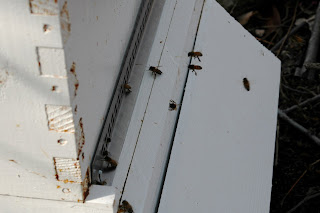
One very interesting observation I made was the amount of dead bees outside of both hives. The 'undertaker bees', the ones responsible for carrying out the dead inside the hive, were very busy.

Below are two pictures, although not as clear as I like (I've made it a point to take better pictures this year)

Here is Genesis: Lot's of activity.


The work of the 'undertakers'.

Tuesday, March 3, 2009

The Beekeeping Podcast - Episode 001 - Starting Off Right, Five Things

In this episode of The Beekeeping Podcast I recommend five things that a beginner beekeeper can do to get started off right in beekeeping.

Here They Are:

1. Join a local beekeeping club
2. Buy or borrow 'Beekeeping for Dummies'
3. Order equipment catalogues from equipment suppliers
4. Find a beekeeping mentor
5. Attend a local beekeeping class, seminar, or workshop.

To subscribe via iTunes: The Beekeeping Podcast

Listen Now: